
Community College as a Starting Point: The Case for a Two-Year Path
Community college can cut the cost of a four-year degree significantly. Explore how transfer pathways, dual enrollment, and associate degrees actually work.
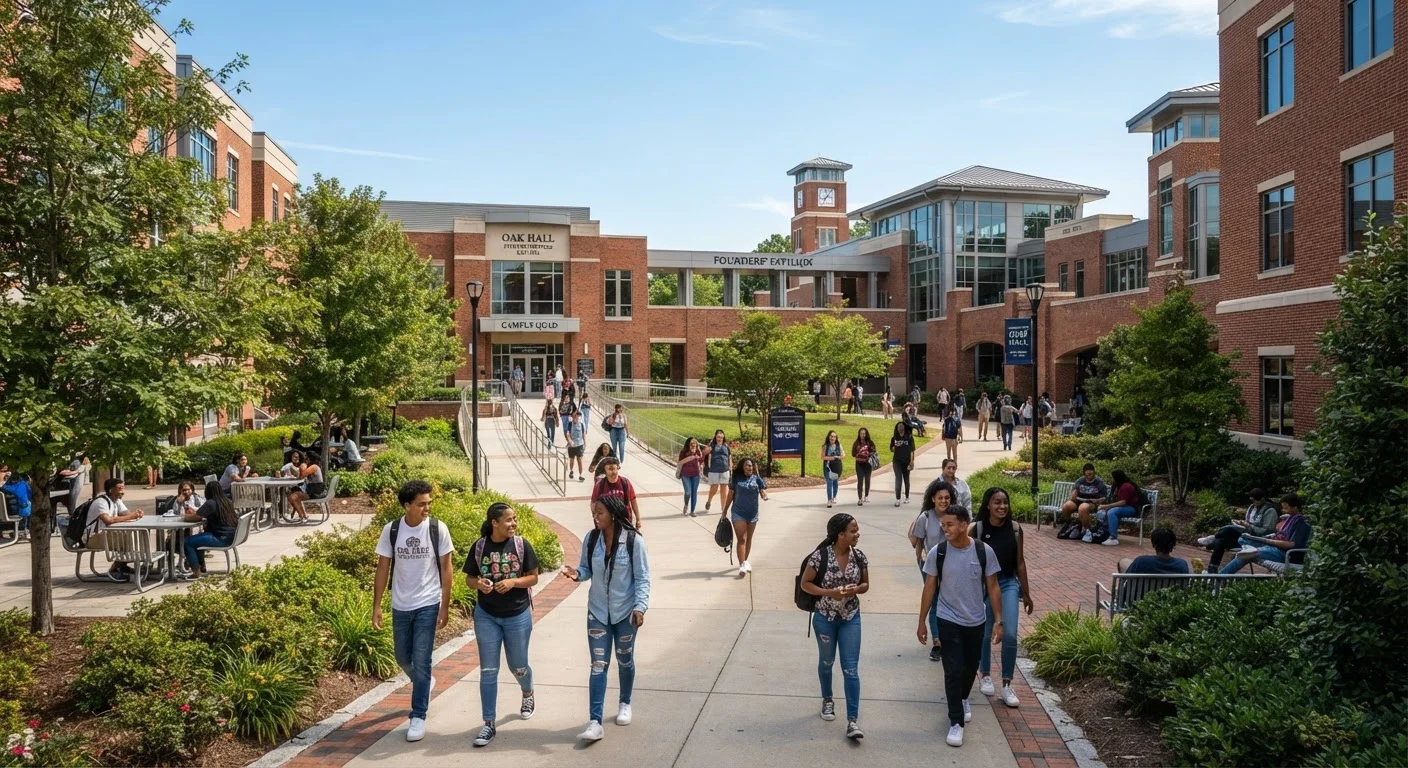
Photo: universalhub.net editorial
—— In This Article
Key Takeaways
- Community college tuition is typically a fraction of four-year university costs, reducing overall debt.
- Transfer agreements between community colleges and universities can preserve access to competitive programs.
- Associate degrees have direct labor market value even without transfer to a four-year school.
- Dual enrollment lets high school students earn college credits before graduation, often at no cost.
- Success in a transfer pathway depends on careful course selection aligned to the destination institution.
Significantly lower tuition than four-year universities
The College Board reports that average community college tuition and fees are well below those at public four-year institutions. Completing the first two years locally can reduce total borrowing before transferring to finish a bachelor's degree.
Transfer agreements preserve access to university programs
Many states have articulation agreements that guarantee admission to a public university system when a student completes an associate degree with a qualifying GPA. California's TAG program and similar state-level agreements elsewhere give transfer students a defined pathway.
Associate degrees carry independent labor market value
In healthcare, technology, and skilled trades, an associate degree or workforce certificate qualifies graduates for employment directly. Students do not have to transfer to benefit from community college enrollment.
Smaller class sizes support students who need more access to instructors
Community colleges often have lower student-to-faculty ratios in introductory courses compared to large research universities, where those courses may be taught in large lecture halls. This access can benefit students who are adjusting to college-level work.
Dual enrollment reduces total college cost for high schoolers
Many community colleges offer dual enrollment programs where high school students take college courses at reduced or no cost. Credits earned count toward degree requirements, shortening time to completion.
Credit transfer is not always guaranteed
Even within articulation agreements, individual courses sometimes do not transfer as direct equivalents. A student who does not research the destination school's requirements carefully may retake coursework, adding time and cost.
Fewer on-campus residential and social resources
Most community colleges are commuter institutions without residential housing, which can limit the network-building and campus life experience that some students consider part of higher education.
Program availability is narrower than at universities
Community colleges focus on general education, workforce programs, and transfer preparation. Students with a specific major in mind, such as architecture or certain engineering disciplines, may find limited coursework available at the two-year level.
Transfer GPA requirements can be competitive at selective universities
Articulation agreements guarantee admission to a university system, not always to a specific campus or program. Impacted programs at flagship campuses may require higher GPAs than the minimum agreement threshold.
Less institutional support for financial aid navigation
Community college financial aid offices often handle large caseloads with limited staffing. Students may need to seek guidance independently to identify all available grants, scholarships, and FAFSA filing support.
How the two-year path actually works
Community college enrollment follows the same FAFSA-based financial aid process as four-year universities. Students apply, declare a program of study, and take courses that either fulfill an associate degree or satisfy general education requirements that transfer to a bachelor's program. The distinction matters: a student pursuing an associate in arts for transfer (AA-T) or associate in science for transfer (AS-T) is on a structured pathway designed to articulate into a specific university system. A student taking individual courses without that structure may find transfers more complicated.
Dual enrollment is a separate but related option. High school students can take community college courses during the school year or summer, earning credit that often applies to both a high school diploma and a future college degree. Families researching how to reduce the overall cost of a four-year degree should read about balancing college savings with existing debt, since early credit accumulation is one piece of a broader financial plan.
The case for starting at a community college
Significantly lower tuition than four-year universities
The College Board reports that average community college tuition and fees are well below those at public four-year institutions. Completing the first two years locally can reduce total borrowing before transferring to finish a bachelor's degree.
Transfer agreements preserve access to university programs
Many states have articulation agreements that guarantee admission to a public university system when a student completes an associate degree with a qualifying GPA. California's TAG program and similar state-level agreements elsewhere give transfer students a defined pathway.
Associate degrees carry independent labor market value
In healthcare, technology, and skilled trades, an associate degree or workforce certificate qualifies graduates for employment directly. Students do not have to transfer to benefit from community college enrollment.
Smaller class sizes support students who need more access to instructors
Community colleges often have lower student-to-faculty ratios in introductory courses compared to large research universities, where those courses may be taught in large lecture halls. This access can benefit students who are adjusting to college-level work.
Dual enrollment reduces total college cost for high schoolers
Many community colleges offer dual enrollment programs where high school students take college courses at reduced or no cost. Credits earned count toward degree requirements, shortening time to completion.
The financial case is straightforward. Completing 60 credits of general education and introductory coursework at community college rates, then transferring for the final two years, reduces exposure to the higher per-credit cost of a four-year institution. Federal Pell Grant eligibility applies to community college enrollment, so lower-income students can reduce out-of-pocket costs further.
For students who are uncertain about their major, community college also provides time to explore without paying university prices for that exploration. Declaring the wrong major and switching at a four-year school costs money; doing that same exploration at community college costs considerably less.
Where the path gets complicated
Credit transfer is not always guaranteed
Even within articulation agreements, individual courses sometimes do not transfer as direct equivalents. A student who does not research the destination school's requirements carefully may retake coursework, adding time and cost.
Fewer on-campus residential and social resources
Most community colleges are commuter institutions without residential housing, which can limit the network-building and campus life experience that some students consider part of higher education.
Program availability is narrower than at universities
Community colleges focus on general education, workforce programs, and transfer preparation. Students with a specific major in mind, such as architecture or certain engineering disciplines, may find limited coursework available at the two-year level.
Transfer GPA requirements can be competitive at selective universities
Articulation agreements guarantee admission to a university system, not always to a specific campus or program. Impacted programs at flagship campuses may require higher GPAs than the minimum agreement threshold.
Less institutional support for financial aid navigation
Community college financial aid offices often handle large caseloads with limited staffing. Students may need to seek guidance independently to identify all available grants, scholarships, and FAFSA filing support.
Articulation agreements vary by state
Not every state has a comprehensive statewide articulation agreement. Some agreements cover only public colleges and universities within the same state system, and private universities may not participate. Before choosing coursework, students should contact the financial aid or transfer office at both the community college and the intended destination school to confirm which credits will transfer and how they will be counted.
The most common planning failure in transfer pathways is assuming that a course taken at a community college will automatically count the same way at a destination university. An introductory economics course, for example, may transfer as a general elective rather than as a specific economics prerequisite, requiring the student to retake the equivalent at the university. Checking the destination school's transfer equivalency database before enrolling in each course avoids this problem.
Making the transfer pathway work
The students who move through community college and into a four-year program efficiently tend to follow a few consistent practices. They identify their target university before or during their first semester at community college. They meet with a transfer counselor at the community college, not only an academic advisor, because transfer counselors track articulation agreements specifically. They apply to the four-year institution at least a semester before they plan to transfer, because admission deadlines and scholarship timelines at receiving institutions are often independent of transfer agreement deadlines.
Students pursuing workforce programs, rather than transfer, benefit from checking regional labor market data through the U.S. Department of Labor's O*NET or their state's workforce agency to confirm that the credential they are pursuing aligns with local employer demand. Community colleges often have career services offices that connect students with local employers directly, which can shorten the time between graduation and employment.
$3,990
Average annual community college tuition and fees
According to the College Board's Trends in College Pricing report, average in-district community college tuition and fees are substantially below public four-year rates.
40%
Share of U.S. undergraduates at community colleges
The American Association of Community Colleges reports that community colleges enroll roughly two in five undergraduate students nationally.
1 in 3
Transfer students who earn a bachelor's degree within six years
National Student Clearinghouse Research Center data indicate that transfer outcomes vary considerably by institution type and state, with planning and program alignment affecting completion rates.

Education Editorial Team
Education Editorial Team is the collective byline for our editorial team and contributor network. Articles published under this byline or an editorial pen name are researched, written, and reviewed according to our editorial standards for clarity, consistency, and independence before publication.
View author profile