
Painting Your Own Walls: What Actually Saves Money and What Does Not
Learn which parts of a DIY paint job genuinely cut costs and where skimping leads to expensive do-overs.
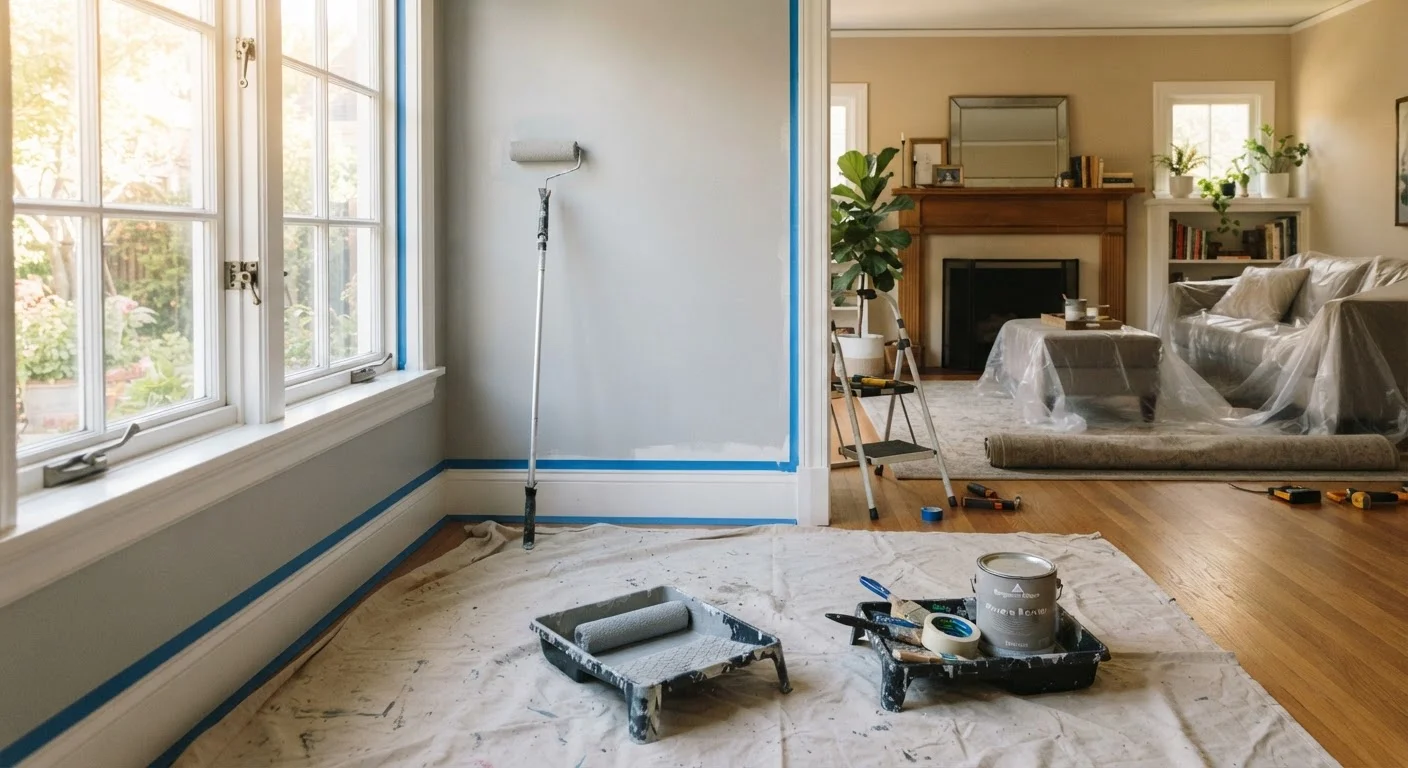
Photo: universalhub.net editorial
—— In This Article
Key Takeaways
- Labor is the biggest cost in professional painting; DIY eliminates it but adds your time.
- Skipping primer or surface prep consistently leads to costly do-overs.
- Cheap paint typically requires more coats, canceling out any upfront savings.
- Good brushes and rollers, cleaned and stored properly, pay for themselves over multiple projects.
- Painter's tape, drop cloths, and adequate lighting are non-negotiable prep expenses worth every cent.
Where DIY painting genuinely cuts costs
Labor is the dominant expense in any professional paint job. When you do the work yourself, you eliminate that cost directly. For a standard bedroom, that can represent a meaningful savings, though the exact amount varies by region, room size, and condition. The costs tied to maintaining a home add up in ways that make each manageable DIY task worthwhile.
Beyond labor, buying materials yourself rather than through a contractor gives you control over what you spend. You choose the paint quality, the roller nap, and how much prep time you invest. That control is the actual financial advantage of DIY painting, not the act of painting itself.
70-80%
Of professional painting cost that is labor
Industry estimates from painting trade associations consistently place labor at the large majority of a professional interior painting quote, with materials making up the remainder.
2-3x
Extra coats often needed with low-coverage paint
Consumer testing by home improvement publications has found that budget paints frequently require additional coats compared to mid-range options to reach comparable opacity.
$200-$400
Typical DIY savings per room vs. hiring out
General contractor cost guides suggest that labor alone for a standard bedroom can run from $200 to $400 or more, which represents the realistic ceiling of DIY savings.
The savings disappear quickly if the job has to be redone. A paint job that fails in 18 months because prep was skipped costs twice: once for your time and materials, and again for the correction. See the home improvement planning checklist before you start any room to avoid that scenario.
The myths that lead to expensive mistakes
Several widely repeated assumptions about DIY painting push people toward decisions that cost more in the end. The myth-fact pairs below address the most common ones.
Myth
Buying the cheapest paint saves the most money on a DIY project.
Fact
Low-cost paint often has lower pigment density, requiring two to three extra coats to achieve coverage that a higher-quality paint reaches in one or two.
Paint price per gallon is not the best unit to evaluate. Coverage per gallon matters more. A paint rated at 400 square feet per gallon at the budget tier may realistically cover 250 to 300 square feet at adequate opacity, while a mid-range paint rated at 350 square feet per gallon often hits that number reliably. When you factor in the additional gallons, your time, and a second or third primer coat on a stained wall, the cheaper option routinely costs more in total. Buy for coverage rating and sheen consistency, not sticker price alone.
Myth
You can skip primer if the paint label says 'paint and primer in one.'
Fact
Paint-and-primer products reduce the need for a separate primer coat in ideal conditions, but they do not replace true primer on new drywall, stained surfaces, or when making a dramatic color change.
The 'paint and primer in one' label refers to a thicker formulation with better adhesion properties. On a previously painted wall in good condition with no stains and a similar color underneath, it works well. On fresh drywall, the paper face still absorbs unevenly without a dedicated drywall primer, causing visible flashing (patchy sheen) in raking light. On water stains or tannin bleed from wood knots, no paint-and-primer hybrid reliably seals the stain: a shellac-based or oil-based primer is still required. Skipping the right primer in these situations means the stain bleeds through, often within weeks.
Myth
Painter's tape is an optional expense if you have a steady hand.
Fact
Painter's tape is less about a steady hand and more about protecting trim, ceilings, and floors from drips and roller spatter that happen regardless of skill level.
A steady hand helps with cutting in at edges, but rollers throw micro-spatter several feet in every direction. Without plastic sheeting on floors and tape protecting baseboards, cleanup becomes a separate project. Dried latex paint on hardwood or tile can be difficult to remove without scratching. The cost of a few rolls of painter's tape and a drop cloth is almost always less than the cost of cleaning up or touching up damage. Tape also lets you work faster without stopping to wipe every edge, which reduces total time on the job.
Myth
Renting professional spray equipment produces a faster, cheaper finish than rolling.
Fact
Spray equipment is faster on bare surfaces with nothing to mask, but in a furnished or partially occupied room, the masking time and overspray risk typically make rolling more practical and less expensive.
Airless sprayers produce a fine finish on cabinets, exterior siding, or empty rooms. In a typical interior room, every outlet, light fixture, window, door, and piece of furniture must be completely covered before spraying. That masking process can take longer than rolling the walls. Rental fees add up by the day, and sprayer cleanup requires solvents and careful flushing. For most DIY interior rooms, a quality roller with a nap thickness suited to the wall texture produces results close to a sprayed finish with far less setup and risk.
Myth
One gallon of paint is enough for any average bedroom.
Fact
An average 12-by-12-foot bedroom with 8-foot ceilings has roughly 350 to 400 square feet of paintable wall area, and most projects require two coats, meaning one gallon is often not sufficient.
Running out of paint mid-wall and buying a second gallon separately creates a real risk: batch variation between cans from different production runs can cause a subtle but visible color shift on the finished wall. Always calculate total square footage, divide by the paint's stated coverage, multiply by the number of coats planned, and buy all gallons at once from the same production batch (check the lot number on the lid). Buying slightly more than the estimate and saving the remainder for touch-ups is cheaper than a mismatch that requires repainting an entire wall.
Prep work determines the final result
No paint, regardless of price or brand, will hide a dirty, cracked, or glossy surface. Washing walls, filling holes, sanding glossy areas, and priming stained spots are steps that directly affect how long a paint job lasts. Skipping them to save an afternoon almost always means repainting within a year or two.
Surface condition is the single factor most people underestimate. Walls with old grease near a kitchen, tannin bleed from wood paneling, or water staining from a repaired leak need targeted treatment before any topcoat goes on. Addressing a water stain correctly also matters for the wall itself: if the source has not been fixed, no paint will hold. The real cost of unrepaired leaks extends well beyond the surface.
What to spend money on without hesitation
Certain expenses in a DIY paint project have a clear payoff and should not be cut.
- A mid-grade roller frame and sleeve rated for your wall texture (smooth, medium, or rough)
- A quality angled brush for cutting in around trim and ceilings, at least 2.5 inches wide
- Plastic drop cloths or canvas tarps for floors and furniture
- Painter's tape suited to the surface (delicate-surface tape near wallpaper or fresh paint, standard tape elsewhere)
- Spackling compound and fine-grit sandpaper for filling and smoothing holes before painting
Low-quality tools cost more over time
Bargain rollers shed fibers into wet paint, leaving texture that requires sanding and recoating. Cheap brushes lose bristles and leave streaks. Replacing them mid-job or buying new ones for the next project erases any savings. Mid-grade tools that are cleaned properly after each use last for years.
A paint job done well once, with proper materials, is also a form of routine home maintenance that protects drywall and trim from moisture and wear. Treating it as a pure cost-cutting exercise rather than a maintenance task tends to produce shortcuts with lasting consequences.
Once the room is freshly painted, small décor adjustments can go a long way. The budget room refresh guide covers low-cost updates that complement a new paint color without requiring a larger renovation.

Home & Garden Editorial Team
Home & Garden Editorial Team is the collective byline for our editorial team and contributor network. Articles published under this byline or an editorial pen name are researched, written, and reviewed according to our editorial standards for clarity, consistency, and independence before publication.
View author profile